
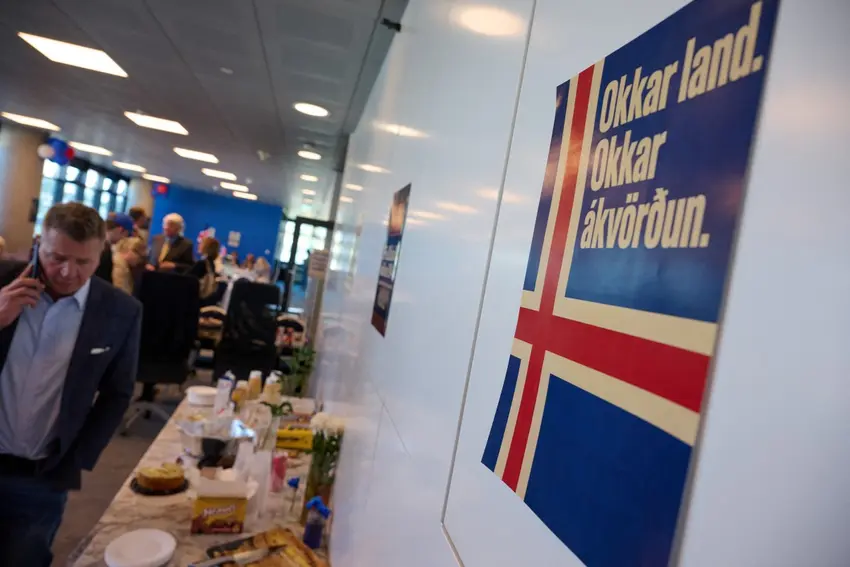
The EU "fully respects the democratic choice" of Icelanders, the European Council President António Costa told Iceland's Prime Minister Kristrún Frostadóttir following the announcement of the referendum results.
The North Atlantic island is already closely linked to the EU as a member of the European Economic Area (EEA) and the Schengen area. The two leaders pledged to "continue to strengthen this relationship."
However, dismay was palpable in Brussels.
"The takeaway is clear: the EU today no longer inspires dreams," said Green MEP Saskia Bricmont.
Centrist MEP Sandro Gozi, meanwhile, called the result a "warning that Europe must take seriously."
He stated that the EU's "power of attraction" should not be "taken for granted" and that it must "continue to earn trust," particularly by reducing bureaucracy.
The EU last expanded in 2013 with the admission of Croatia. Although enlargement has returned to the forefront as a strategic priority since Russia's invasion of Ukraine in 2022, achievements obtained since then have been sparse.
Model Candidate
Recent years have been marked by modest progress among Western Balkan candidates—with Montenegro and Albania being the closest to joining—and by the opening of a vast and complex accession process with Ukraine.
READ MORE: Who could be the next country to join the EU?
Brussels took care not to give the impression of interfering in this weekend's Icelandic vote, but made little secret of its enthusiasm at the prospect of welcoming this wealthy and strategically located island into the EU.
For many European capitals, Iceland appeared to be a model candidate, and Brussels had indicated its readiness to make concessions on sensitive issues, such as fishing rights, to facilitate its integration.
It seems this message had little resonance with the roughly 400,000 Icelanders, who voted 52.8 percent to 47.2 percent against resuming accession negotiations that were suspended 13 years ago, effectively burying the issue for the foreseeable future.
Eurosceptics rejoiced at the outcome.
Marine Le Pen, leader of the French far right, declared that it demonstrated the appeal of a Europe of "free and sovereign nations" compared to deeper integration.
Nigel Farage, leader of the Reform UK party, congratulated Icelanders for having "voted to preserve their independence."
This "no" from Iceland, despite an "uncertain" international security context, "should give Brussels food for thought," according to the ECR group on the right wing of the European Parliament.
The group's co-chairman, Nicola Procaccini, stated that Brussels should reflect on why "a prosperous, democratic European country open to the world" chose not to restart accession talks.
Geopolitical Pressures
Geopolitics weighed heavily on the referendum, as US President Donald Trump's threats to take control of Greenland resonated in neighbouring Iceland, whose security relies on NATO.
Ultimately, however, the debate focused on issues such as fishing and the volatility of the Icelandic currency.
The Icelandic vote represents a setback in the EU's quest to strengthen its presence in the Arctic region.
European Commission President Ursula von der Leyen is scheduled to visit Greenland in September.
MEP Kathleen Van Brempt, from the Socialists and Democrats group, stated that Arctic security cooperation with Iceland remained "more important than ever," promising that work would continue "openly and respectfully."
Her Socialist colleague Andreas Schieder emphasised that Iceland "was and remains a member of the European family."
"It is now a matter of resisting geopolitical pressures together," he said.
Iceland's "no" is "a sovereign choice that we respect," stated French Minister Delegate for Europe Benjamin Haddad.
"Unlike the predatory empires that surround us, our Europe respects the sovereignty of the peoples who wish to join or leave it. That is its strength," he added.
Comments (5)